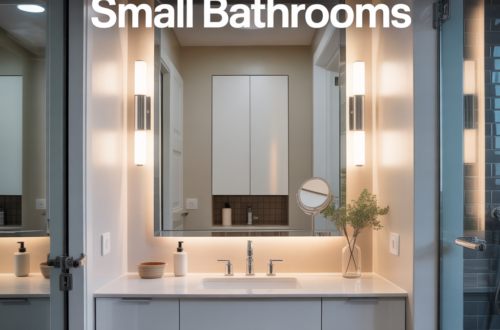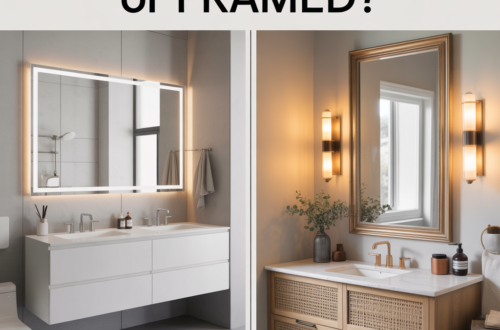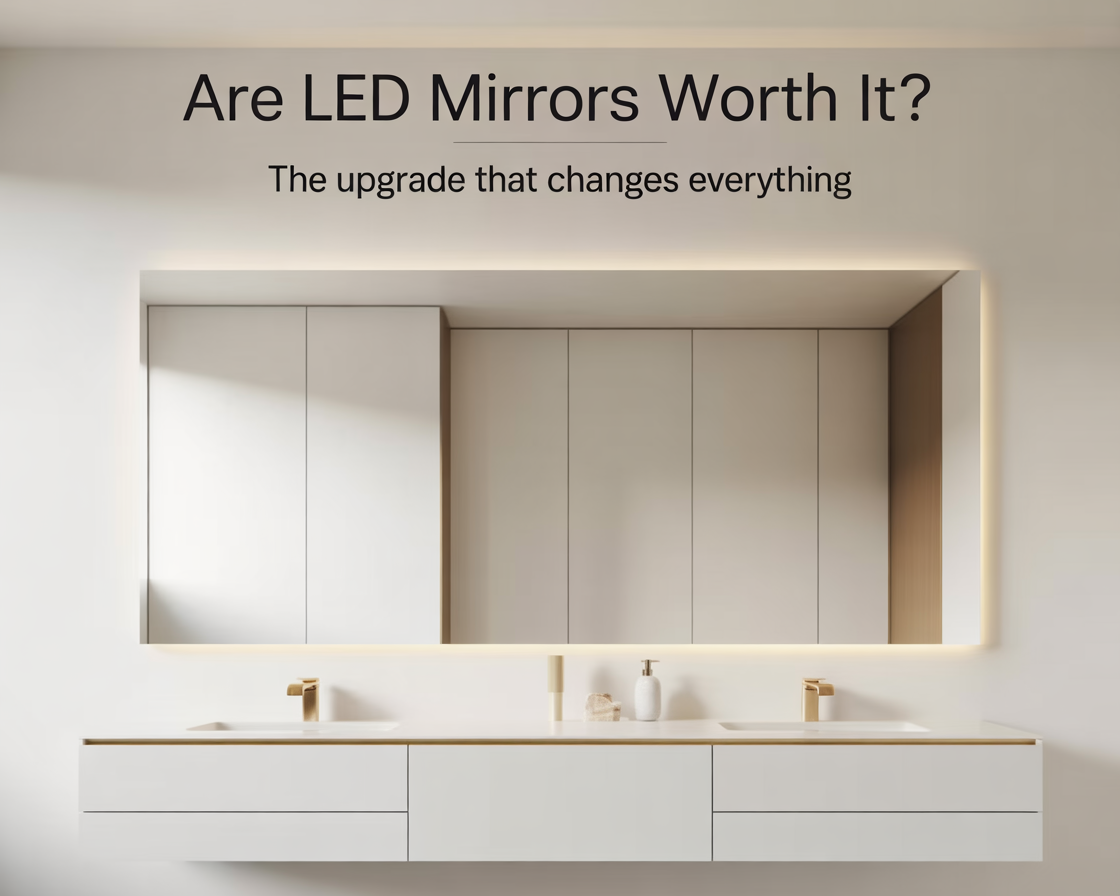
I bought an LED backlit mirror on impulse during a bathroom refresh last year. I’d seen them everywhere — hotel bathrooms, design accounts, renovation reveals — and they always looked incredible. Floating on the wall with that soft glow around the edges, making the whole bathroom feel like somewhere you’d actually want to spend time.
Mine looked nothing like that for the first three weeks. The problem wasn’t the mirror. It was that I hadn’t thought through what an LED mirror actually does and what it needs around it to do it well. Once I figured that out, the mirror became the best thing in the bathroom. But it took some adjustment I didn’t expect.
Here’s what I wish someone had told me before I bought it — and a genuine answer to whether they’re worth the money.
What an LED backlit mirror actually does
There are two types of LED bathroom mirrors and people often confuse them. A backlit mirror has LEDs mounted behind the mirror, facing the wall — the light doesn’t shine directly at your face, it creates a halo of illumination around the mirror’s perimeter and bounces off the wall behind it. A front-lit mirror, sometimes called a lighted mirror, has LEDs on the front face — usually along the top or sides — that shine directly forward and illuminate your face.
These do very different things. Backlit mirrors create ambiance. The glow they produce is atmospheric and warm, and they make the mirror appear to float on the wall. Front-lit mirrors provide functional task lighting — they’re what you want if you’re applying makeup, shaving, or doing anything that requires seeing your face clearly under even light.
The most useful LED mirrors combine both. Backlight for atmosphere, front or side lighting for function. Most mid-range and higher-end models offer this, often with separate controls for each. If you’re looking at a mirror with only backlighting and no front illumination, understand that you’re buying primarily for aesthetics, not practical bathroom lighting.
The lighting problem they solve — and the one they don’t
The worst lighting situation in any bathroom is a single overhead fixture mounted directly above the mirror. That position puts light on top of your head and creates shadows under your nose, chin, and eyes — exactly the areas where you’re trying to see yourself clearly. It’s the least flattering and least functional arrangement possible, and it’s what most bathrooms have by default.
An LED mirror with front or side lighting solves this completely. Light coming from in front of your face, at roughly face height, is the correct position for task lighting in a bathroom. It’s why professional makeup artists and theatrical dressing rooms use bulbs arranged around a mirror rather than above it. The illumination is even, shadow-free, and genuinely useful.
What an LED mirror doesn’t solve is overall bathroom lighting. The glow from a backlit mirror is beautiful but it doesn’t light a bathroom the way a proper ceiling fixture does. If your bathroom has no overhead lighting and you’re hoping the LED mirror will replace it, you’ll end up with a dramatically lit mirror surrounded by a dark room. That looks striking in a hotel with dramatic design intent. In a regular bathroom where you’re trying to find your toothbrush at 6am, it’s not ideal.
LED mirrors work best as an addition to adequate overall lighting — not as a replacement for it.
Color temperature: the detail that determines everything
This is what I got wrong the first time, and it’s the thing most reviews gloss over entirely.
LED lights are measured in Kelvin — a scale that runs from warm yellow-white at the low end (2700K) to cool blue-white at the high end (6500K). The color temperature of your LED mirror’s light has an enormous effect on how the mirror looks, how your face looks in it, and how the bathroom feels overall.
Mirrors set to a very cool temperature — 5000K or above — produce light that reads as slightly clinical. It’s accurate in the sense that it shows color faithfully, which is useful for makeup application. But it makes the bathroom feel like a laboratory and makes most people look slightly worse than they do in warmer light. Pale, slightly flat, shadows emphasized rather than softened.
Mirrors set to a warmer temperature — 2700K to 3000K — produce light that feels flattering and human. The bathroom looks inviting. The glow around the mirror is warm and soft rather than stark. The trade-off is slight color distortion — warm light makes everything look slightly more golden, which can affect how you judge makeup colors.
The best mirrors offer adjustable color temperature — usually called a CCT dimmer or color tuning feature. You can set it warm for evening ambiance and cooler for precise morning grooming. If you’re buying a fixed-temperature LED mirror, 3000K is the most versatile single setting: warm enough to be flattering, cool enough to be accurate.
My mirror was set to 6000K out of the box. That’s why it looked like a hospital fixture for the first three weeks. When I found the temperature control and brought it down to 3000K, the bathroom transformed.
The installation question
LED mirrors require a hardwired electrical connection or a nearby outlet — they’re not like regular mirrors you can simply hang on a wall. This is the practical hurdle that catches people off guard, and it’s worth thinking through before you buy.
If your bathroom already has a junction box behind where your mirror hangs — which is common in bathrooms that previously had a light bar or sconce at mirror height — hardwiring an LED mirror is relatively straightforward for an electrician and sometimes manageable as a DIY project if you’re comfortable with basic electrical work. If there’s no existing wiring at mirror height, you’re looking at running new wire, which is a more involved job.
Some LED mirrors are designed to plug into a standard outlet, which simplifies installation significantly but requires a nearby outlet and leaves a visible cord unless it’s managed carefully. In a bathroom with an outlet near the mirror, this is a reasonable solution. In a bathroom where the nearest outlet is at counter level and the mirror is three feet higher, the cord management becomes its own problem.
Factor installation into your total cost before comparing the price of an LED mirror to a standard one. A mirror that costs twice as much but requires a few hundred dollars of electrical work costs considerably more than the sticker price suggests.
What you actually get for the money
LED bathroom mirrors range from around eighty dollars at the low end to several hundred or more for larger, feature-rich models. What changes across that price range is worth understanding.
Inexpensive LED mirrors often have fixed color temperature, lower-quality glass that distorts slightly at the edges, and LED strips that aren’t fully sealed against moisture. In a bathroom with steam and humidity, inadequately sealed LEDs can fail within a year or two. The IP rating — Ingress Protection — tells you how well sealed the electronics are. Look for IP44 at minimum for a bathroom environment. IP65 or higher is better if your mirror will be near a shower with significant steam.
Mid-range mirrors — roughly 150 to 300 dollars — typically offer adjustable color temperature, dimming capability, better glass quality, and adequate moisture protection. This is where most people find the best balance of quality and cost. The features that matter most are present without paying for things like Bluetooth speakers and defogging pads that sound useful but rarely get used.
The defogging feature specifically: it uses a heating element behind the mirror to prevent condensation after showers. In a well-ventilated bathroom with a working exhaust fan, you probably don’t need it. In a poorly ventilated bathroom where the mirror fogs constantly, it’s genuinely useful. Worth paying for in the second situation, unnecessary in the first.
Are they worth it — the actual answer
For most bathrooms, yes — with conditions.
They’re worth it if your bathroom currently relies on overhead lighting that puts shadows on your face. The functional improvement in grooming light quality alone justifies the cost for anyone who cares about seeing themselves clearly. They’re worth it if you want your bathroom to feel more considered and less utilitarian — the ambient glow of a backlit mirror does more for the atmosphere of a bathroom than almost any other single change.
They’re less worth it if your bathroom already has good side or front lighting at face height, or if you have no convenient electrical connection at mirror height and the installation cost would be significant. They’re not worth it at all if you buy one at 6000K color temperature, hate the way it looks, and never figure out that there’s a temperature control.
That last one is more common than it should be. Check the color temperature before you buy. Set it to 3000K when it arrives. Give it two weeks before you decide whether it was worth the money.
Mine has been on the wall for fourteen months. I haven’t once wished I’d bought a regular mirror instead.