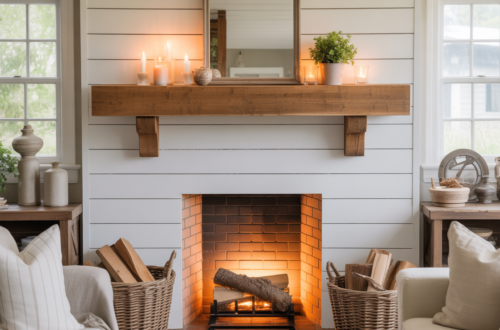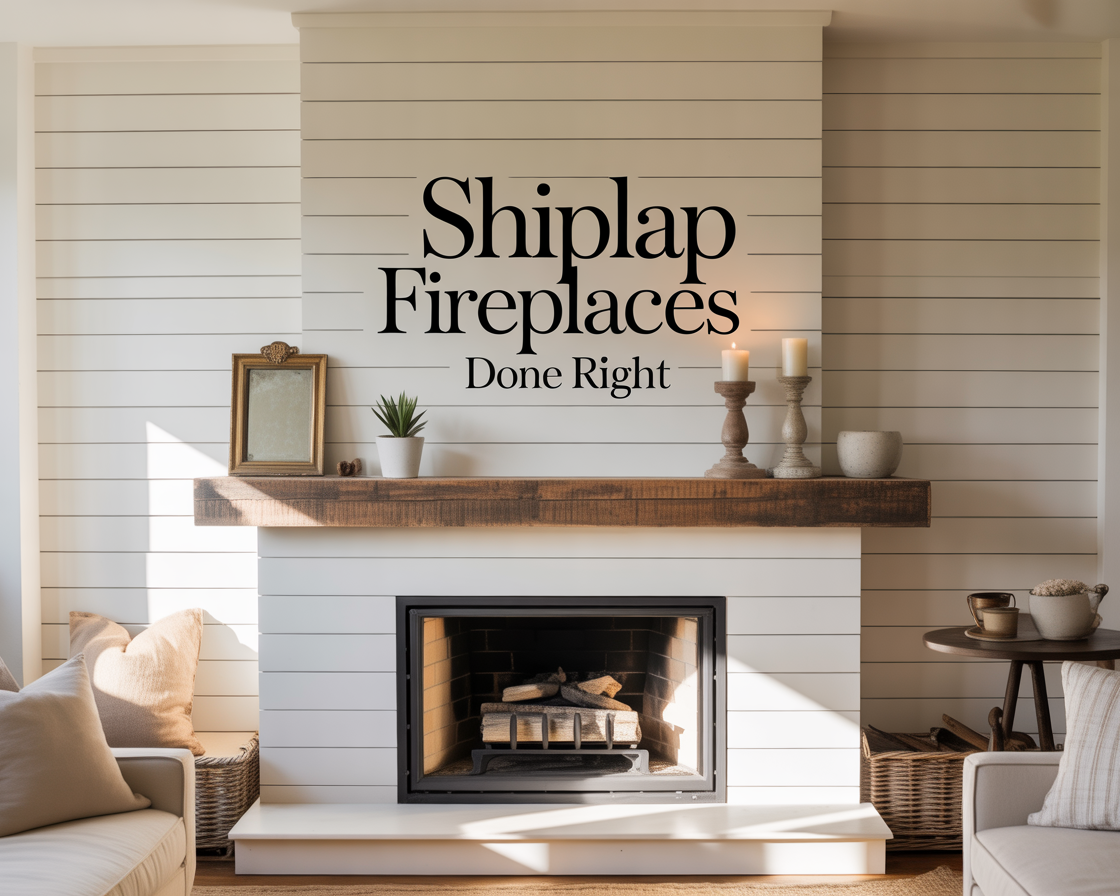
The first time I saw shiplap around a fireplace in person — not in a magazine, not on a screen, but in an actual room — I understood immediately why it works. The horizontal lines of the boards draw the eye outward, making the fireplace feel wider and more anchored. The texture of the wood, even painted white, catches light differently across the day. The shadow lines between boards at 2pm look different from the same boards at 7pm with a fire lit below them. The wall breathes.
I’ve since added shiplap to two fireplaces. The first was an existing brick fireplace that needed updating. The second was a built surround on a blank wall with no firebox at all. Both times, shiplap was the single decision that made the fireplace feel genuinely farmhouse rather than farmhouse-adjacent. Here’s what I’ve learned about using it well.
Why shiplap works so well around fireplaces specifically
Shiplap is horizontal by nature, and horizontality does something specific in a room: it grounds. Vertical lines pull the eye up and create height. Horizontal lines push outward and create stability, weight, presence. Around a fireplace — which is already a vertical focal point in a room — horizontal shiplap provides a counterbalancing grounding effect that makes the whole composition feel resolved.
The other thing shiplap does is add texture without adding color. When painted white — which is its most common application in farmhouse design — shiplap reads as a textured white wall rather than as wood. The texture is present through the shadow lines between boards, through the slight variation in surface that no perfectly smooth wall can replicate. It looks like something. A flat painted wall looks like nothing.
Around a fireplace, that texture matters because the fireplace is already a rich, complex visual element — the mantel, the firebox, the hearth, the styling above. Shiplap provides a backdrop that has presence without competing. It’s the supporting actor that makes the lead look better.
Full wall vs. inset panel — the first decision
Shiplap around a fireplace can be applied in two fundamentally different ways, and the choice shapes the entire look of the room.
Full wall shiplap — running the boards across the entire wall from corner to corner, floor to ceiling, with the fireplace set into the continuous surface — creates a statement. The fireplace becomes part of a larger architectural moment rather than a standalone object on a plain wall. This approach works best in rooms where the fireplace wall is the clear focal wall, where you want the whole wall to command attention, and where the room has enough scale to absorb the visual weight of a fully clad wall.
Inset panel shiplap — running the boards only in the area immediately surrounding the firebox, contained within the mantel surround — is more contained and more traditional in its proportions. The shiplap appears as a material choice within the fireplace rather than as a whole-wall decision. It’s easier to execute, works in smaller rooms, and creates a more classic farmhouse look that doesn’t require the room to accommodate a fully shiplapped wall.
Neither is better in any absolute sense. Full wall is bolder and more contemporary farmhouse. Inset panel is more classic and more transferable across different room sizes and styles. What matters is that the choice matches the scale of the room and the commitment level of the overall design direction.
White painted shiplap — the classic and still the best
White painted shiplap is the version that defined farmhouse style in the popular imagination, and it remains the most versatile application for a reason. White reads as both historic and contemporary. It works with warm wood mantels and cool white mantels. It works in rooms with dark floors and rooms with light floors. It pairs with every color palette a farmhouse-style room might use.
The specific white matters more than most people realize. A cool, bright white — blue-toned, highly reflective — makes shiplap look clean and slightly modern. A warm white — cream-toned, slightly matte — makes it look older, more worn, more genuinely farmhouse. For most farmhouse applications, the warm white is the better choice. It ages better visually, it doesn’t show dust and scuffs as harshly, and it has a quality of light that feels domestic rather than commercial.
The finish matters too. Semi-gloss is easy to clean but reflects light in a way that emphasizes every imperfection in the boards and makes the shadow lines between them look more pronounced — which can be good or bad depending on preference. Eggshell or satin is more forgiving on the surface texture and produces a softer, less reflective result. For shiplap around a fireplace specifically — where the boards will be seen close up and in firelight — eggshell is almost always the better finish.
Natural and stained wood shiplap — the less-expected version
Painted white shiplap is the expected choice. Natural or stained wood shiplap around a fireplace is the version that surprises people and, in the right room, creates something more distinctive.
Natural pine shiplap — unfinished or finished with a clear coat only — brings warm honey tones to the fireplace wall. In a room that already has warm wood elements, natural shiplap creates a cohesive, deeply warm environment. In a room with cooler elements — gray tile, cool stone, blue-toned fabrics — it provides a warm counterpoint that prevents the room from feeling cold.
A gray or weathered stain on shiplap is the version that reads most contemporary while still being clearly farmhouse. The gray wash references the look of old barn wood without the actual irregularity and roughness of salvaged timber. It works particularly well in rooms where the farmhouse aesthetic is being used as a starting point rather than a complete commitment — rooms that also have modern furniture, clean-lined hardware, or contemporary lighting.
Dark stained shiplap — walnut tones, deep espresso — is less common and genuinely striking when executed well. A fireplace wall in dark-stained shiplap with a lighter mantel and bright hearth creates a dramatic contrast that’s still clearly farmhouse in its material vocabulary. This is the version that requires the most confidence and the most commitment from the rest of the room — lighter walls, light furniture, deliberate counterbalancing warmth — to prevent the fireplace wall from feeling heavy and oppressive.
Combining shiplap with brick or stone
Shiplap doesn’t have to be the only material in a farmhouse fireplace surround. Combining shiplap with brick or stone is one of the richest approaches available — two materials that both read as historic and authentic, each one making the other look more intentional.
The most common arrangement: shiplap on the outer fireplace wall and brick or stone in the firebox surround itself — the area immediately around the firebox opening. The transition from wood to masonry marks the boundary between the decorative surround and the fire area in a way that feels both functional and beautiful. The roughness of the brick or stone against the regularity of the shiplap creates a textural contrast that’s deeply satisfying.
Stacked stone veneer around the firebox with white shiplap extending outward to the full wall is a version that has appeared constantly in farmhouse renovation projects for the past decade. The stone reads as ancient and immovable. The shiplap reads as hand-built and warm. Together they create a fireplace wall that feels like it has a history, even when the house was built last year.
Brick — real or thin veneer — in the firebox area with white shiplap surrounding it is the more classic version and slightly easier to execute. The brick can be left in its natural red-orange tone for maximum warmth, painted white for a more unified palette, or whitewashed to land somewhere in between. Whitewashed brick with white shiplap creates a tone-on-tone texture wall that looks softer and more organic than either material alone.
Real shiplap vs. shiplap-look alternatives
Traditional shiplap is a specific type of board with a rabbet cut along each edge so the boards overlap slightly when installed. Real shiplap has a depth and shadow line between boards that is subtly different from the alternatives — slightly more pronounced, slightly more three-dimensional.
The alternatives are widely used and genuinely close in appearance. V-groove paneling — boards with a V-shaped groove cut into each joint rather than a rabbet — creates a similar horizontal line effect with a more precise, slightly more formal shadow line. Nickel gap shiplap — boards installed with a small deliberate gap between them — creates a cleaner, more modern look than traditional overlapping shiplap. Flat boards installed with a consistent gap using spacers is the DIY version of the same effect and costs the least of any approach.
For a fireplace surround specifically, the difference between real shiplap and well-installed alternatives is minimal at normal viewing distance. The gap between boards — whether from a rabbet, a V-groove, or deliberate spacing — is what the eye reads as shiplap. The specific method of achieving that gap matters primarily to people who know to look for it, which is not most guests standing in your living room.
The installation details that make the difference
Shiplap around a fireplace needs to be level and consistent in its spacing to look right. A single board that runs slightly off level — barely noticeable on its own — becomes obvious when the boards above and below it are perfectly horizontal. The eye catches inconsistency in horizontal lines faster than almost anything else.
Start from a level reference line drawn at a comfortable working height — usually the third or fourth board from the bottom — and work both up and down from it. This prevents small errors from accumulating over the height of the wall. Check each board with a level before nailing, not after.
The gap between boards — the shadow line — should be consistent throughout. A nickel coin used as a spacer creates a gap that’s slightly less than 2 millimeters, which reads as a clean, tight shadow line. A wooden dowel used as a spacer creates a wider gap for a more pronounced effect. Both are legitimate choices; what isn’t legitimate is inconsistency. Variable gaps read as mistakes even when they’re not.
Caulk is the finishing detail that separates a professional-looking installation from an amateur one. Caulk along the top and bottom edges of the shiplap run, along any inside corners, and where the shiplap meets the mantel surround. Paint over the caulk when it’s fully dry. The joints disappear and the whole installation looks like it grew there.
What the first shiplap fireplace taught me
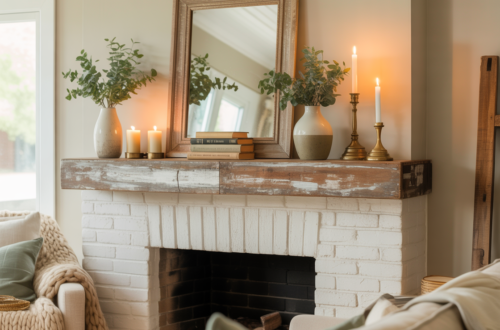
The brick fireplace I updated first was original to the house — early 1970s, functional but dated. The brick was an orange-red that had seen better days. I considered replacing the surround entirely, got a quote, and declined. Instead I installed white painted shiplap on the wall from the mantel to the ceiling, replaced the old wood mantel with a reclaimed beam, and painted the brick white.
Total material cost was under three hundred dollars. The fireplace went from the least interesting thing in the room to the first thing anyone noticed. The shiplap above the mantel — simple, white, horizontal — framed the whole composition and gave the eye a clear path: up from the hearth, across the mantel, out along the boards, back to the center.
Someone asked recently if the shiplap was original to the house. It’s not — it’s less than four years old. But it looks like it was always there, which is exactly the goal. Farmhouse style, at its best, looks like time rather than trend. Shiplap around a fireplace is the fastest way to get there.