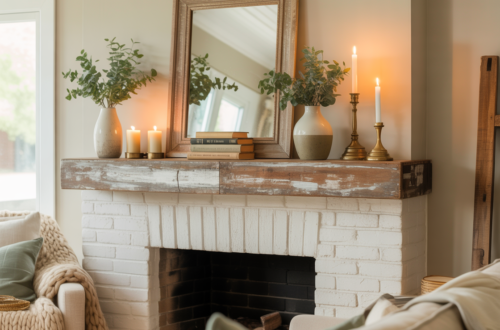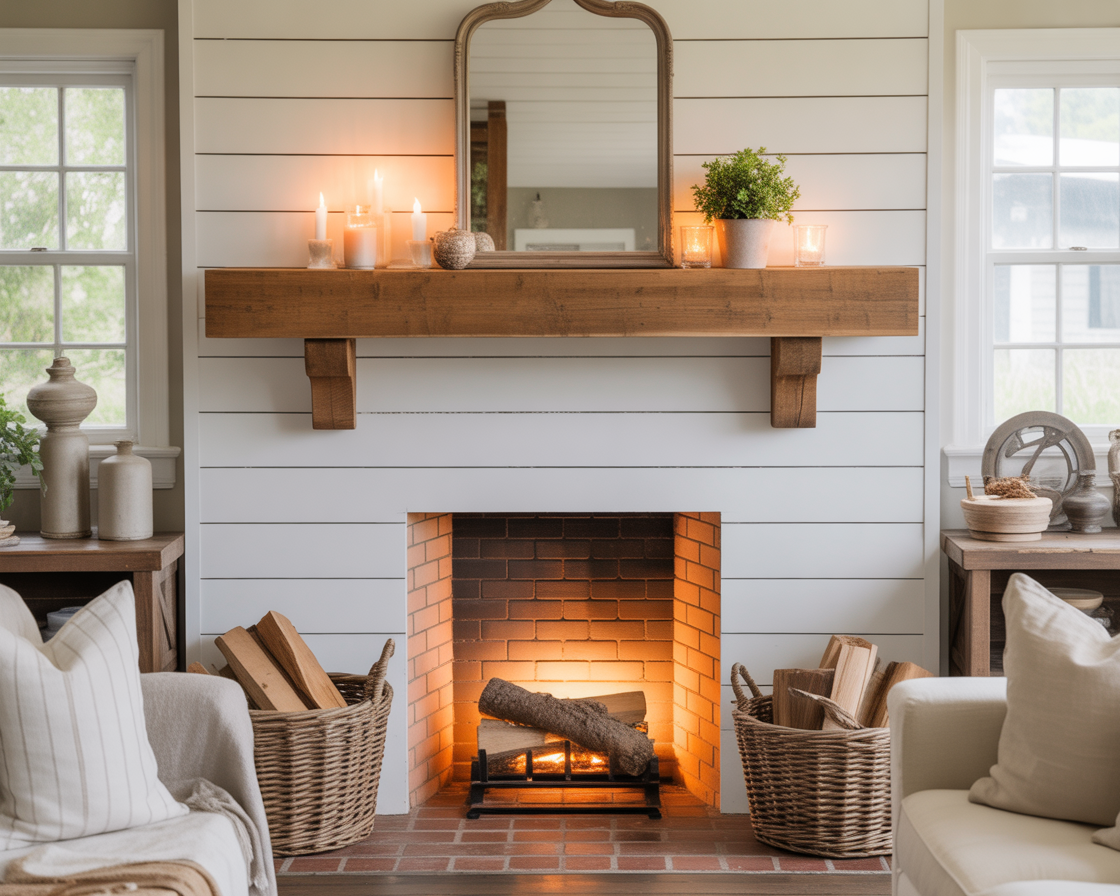
My living room had a blank wall. Not a bad wall — just empty, with no particular reason to look at it. The room functioned fine but it had no focal point, no place the eye went first when you walked in. I’d been thinking about adding something there for two years and doing nothing about it because everything I found online either required actual construction or cost more than I wanted to spend.
Then I built a farmhouse fireplace surround for just under two hundred dollars. No working firebox, no gas line, no masonry — just a structure that looks like a fireplace, reads like a fireplace, and turned that blank wall into the reason people walk into the room and immediately say something.
It took one weekend. Here’s how it works and what actually matters when you’re doing it on a real budget.
What a farmhouse fireplace actually consists of
Before building anything, it helps to understand what creates the farmhouse fireplace look — because knowing the components tells you where the money needs to go and where you can cut without it showing.
A farmhouse fireplace surround has three main parts. The mantel shelf — the horizontal surface that runs across the top, where you put candles and objects and seasonal decorations. The mantel legs — the vertical supports on either side that connect the shelf to the floor or to a base. And the firebox opening — the recessed or framed space in the center that reads as the fire area, whether or not it contains anything functional.
The farmhouse version of this is distinguished by its materials and proportions. Thick, substantial mantel shelf — often reclaimed wood or wood that looks reclaimed. White painted legs, usually with some molding detail that gives them character without being ornate. A simple firebox opening framed in brick, shiplap, or painted wood. The whole thing is slightly oversized rather than delicate, slightly imperfect rather than pristine. That combination of weight and simplicity is the farmhouse quality.
Understanding this means understanding where the money has most impact. The mantel shelf is what people look at first and touch first — it needs to feel substantial and real. The legs and surrounding structure matter for proportion and character but can be built simply. The firebox interior, paradoxically, matters least — once you put candles or an electric insert in it, most of it disappears.
The mantel shelf — spend here
The single most important element of a farmhouse fireplace surround is the mantel shelf, and specifically its thickness and material. A thin shelf looks cheap regardless of what’s around it. A thick shelf — three inches minimum, four or five for a more substantial look — reads as architectural and real.
Reclaimed wood is the ideal material and it doesn’t have to be expensive if you know where to look. Architectural salvage yards, habitat for humanity ReStores, Facebook Marketplace, and Craigslist all regularly have reclaimed beams and boards at a fraction of what lumber yards charge for new wood sold as reclaimed. A genuine reclaimed beam four inches thick and six feet wide — enough for most fireplace mantels — can often be found for twenty to fifty dollars if you’re patient and willing to search.
If you can’t find reclaimed wood or don’t want to wait, new lumber can be made to look reclaimed with a few hours of work. A belt sander with coarse grit removes the factory smoothness. A wire brush run along the grain raises the texture. A diluted dark stain followed by a lighter wash creates depth and the appearance of age. Dings and dents added deliberately — the corner of a hammer, a chain dragged across the surface — create the imperfection that reads as history. Done well, it’s genuinely difficult to distinguish from the real thing at any normal viewing distance.
The surround structure — build simply
The structure that holds the mantel shelf — the legs, the header, the overall frame — can be built from standard pine lumber and MDF without it looking cheap, because it gets painted white and the paint finish is what you see rather than the underlying material.
The most straightforward approach uses 1×4 and 1×6 pine boards as the structural elements, with MDF for any flat panel areas. The legs are built as simple rectangular columns — two boards forming an L-shape, which is hollow, light, and easy to handle. The header runs between the tops of the legs and supports the mantel shelf above it. Basic trim molding along the edges of the legs and around the firebox opening provides the detail that makes the structure look designed rather than assembled.
Farmhouse style is forgiving of simplicity. Unlike Victorian or classical mantels with elaborate carved decoration, farmhouse mantels are intentionally plain — the character comes from the material and the proportions, not from ornamental detail. A straight-edged column with a single piece of crown molding at the top and a simple base molding at the bottom looks completely appropriate and requires no advanced carpentry skill.
The proportions matter more than the finish. A mantel that’s too narrow for the wall looks like it’s apologizing for itself. A mantel that’s proportional — roughly as wide as a sofa, tall enough that the mantel shelf sits at around 54 to 60 inches from the floor — looks like it was always there.
The firebox — keep it simple
The firebox opening is the recessed area in the center of the surround that creates the illusion of a functional fireplace. This doesn’t require depth or actual construction — it can be as simple as a flat panel set back slightly from the face of the surround, painted black or very dark charcoal to read as a deep recess.
Black painted MDF on the back wall and sides of the firebox, with a simple painted border around the opening, creates a convincing firebox at minimal cost. If you want more texture — and texture is what farmhouse style is about — paint the firebox interior with a concrete or stone texture paint, or apply a thin layer of actual mortar tinted gray and textured with a sponge. Both options cost under twenty dollars in materials and add significant visual authenticity.
The bottom of the firebox — the hearth — is where a small investment pays the most. A piece of slate tile, a few bricks laid in a simple pattern, or even a piece of textured stone-effect vinyl flooring cut to size creates a hearth that grounds the whole structure. The hearth is what makes a fireplace surround feel like a fireplace rather than just a frame on a wall. Don’t skip it.
What to put inside — the question after the structure
Once the surround is built and painted, the firebox interior needs something. The options split into functional and decorative, and which you choose depends on your priorities and your budget.
An electric fireplace insert is the closest to a real fire experience without actual combustion. Entry-level electric inserts start at around sixty to eighty dollars and produce both light and heat. The flame effect on inexpensive models isn’t particularly convincing up close, but at normal living-room distance, with the surround around it and candles on the mantel above, it reads well. Mid-range models at 150 to 200 dollars have significantly better flame simulation that holds up to closer inspection.
Candles are the most farmhouse-appropriate solution and the cheapest. A cluster of pillar candles in varying heights, on a simple tray or directly on the hearth, looks exactly right in a farmhouse fireplace and costs almost nothing. In the evening with the candles lit, the effect is genuinely warm and beautiful — arguably more so than an electric insert. The limitation is that candles require attention and should never be left unattended.
Stacked birch logs are the purely decorative option that requires no electricity and no fire management. A neat stack of white birch logs in the firebox — available at craft stores, garden centers, or collected from wherever birch trees are felled nearby — fills the space beautifully and adds a material texture that feels entirely consistent with the farmhouse aesthetic. In a room with good ambient lighting, it reads as warm without producing any light itself.
The mantel styling — where everyone overthinks
A built farmhouse fireplace with a badly styled mantel is a disappointment. A simply styled mantel with just a few well-chosen elements is far stronger than an overcrowded one trying to check every farmhouse box at once.
The mantel needs a focal point — usually something vertical that commands the space above the shelf’s center. A large mirror is the classic choice and the most practical: it reflects light into the room, makes the ceiling feel higher, and provides a visual anchor without competing with the fireplace itself for attention. A piece of simple artwork in a substantial frame does the same job with more character.
Around the focal point, add two or three objects of varying height — a lantern, a small plant, a simple ceramic piece — that frame the central element without crowding it. Odd numbers feel more natural than even ones. Groupings of three almost always work. Groupings of four or six almost always feel too symmetrical and arranged.
Resist the seasonal-farmhouse-styling instinct to add a wreath, a sign with words on it, three different textures of foliage, and a collection of vintage-look objects all at once. That’s the version of farmhouse that tips into costume rather than character. Restraint on the mantel makes the fireplace look more expensive and more considered than abundance ever does.
The real cost breakdown
Reclaimed wood mantel shelf (salvage)
$20–50
Pine lumber for surround structure
$40–60
MDF for panels and firebox
$15–25
Trim molding
$15–20
Paint (white + black)
$20–30
Slate tile or brick for hearth
$15–30
Screws, wood glue, caulk
$10–15
Total (without insert)
$135–230
With entry-level electric insert
Add $60–80
What the blank wall became
The fireplace on my blank wall cost $187 in materials. I had most of the tools already — a miter saw borrowed from a neighbor, a drill, a nail gun that was worth buying for this project and has been used six times since. The mantel shelf came from a salvage yard for thirty-five dollars: a genuine old beam, rough and heavy and imperfect in exactly the right ways.
It took a Saturday to build the structure, a Sunday morning to paint, and a Sunday afternoon to install and style. I put pillar candles in the firebox on a slate tile hearth. A large vintage-style mirror above the mantel. Two small plants and a ceramic lantern flanking it.
The room has a focal point now. People walk in and go toward it — not because I’ve told them to but because the room has a center of gravity it didn’t have before. Someone asked recently which contractor built it. I said I did, over a weekend, for under two hundred dollars. They didn’t believe me until I showed them the photos of the blank wall before.
That’s what a farmhouse fireplace does to a room. It gives it somewhere to be.