I’ve changed the mirror in my bathroom twice. The first time I picked a chunky wood-framed one because it was on sale and looked nice in the store photo. In my actual bathroom — white tiles, chrome faucets, modern vanity — it stuck out like furniture from a different house. I lived with it for eight months before finally swapping it out.
The second time I thought it through. And the bathroom finally felt like one coherent space.
Here’s what I learned about choosing between frameless and framed mirrors — and why the decision matters more than most people think.
What actually makes them different
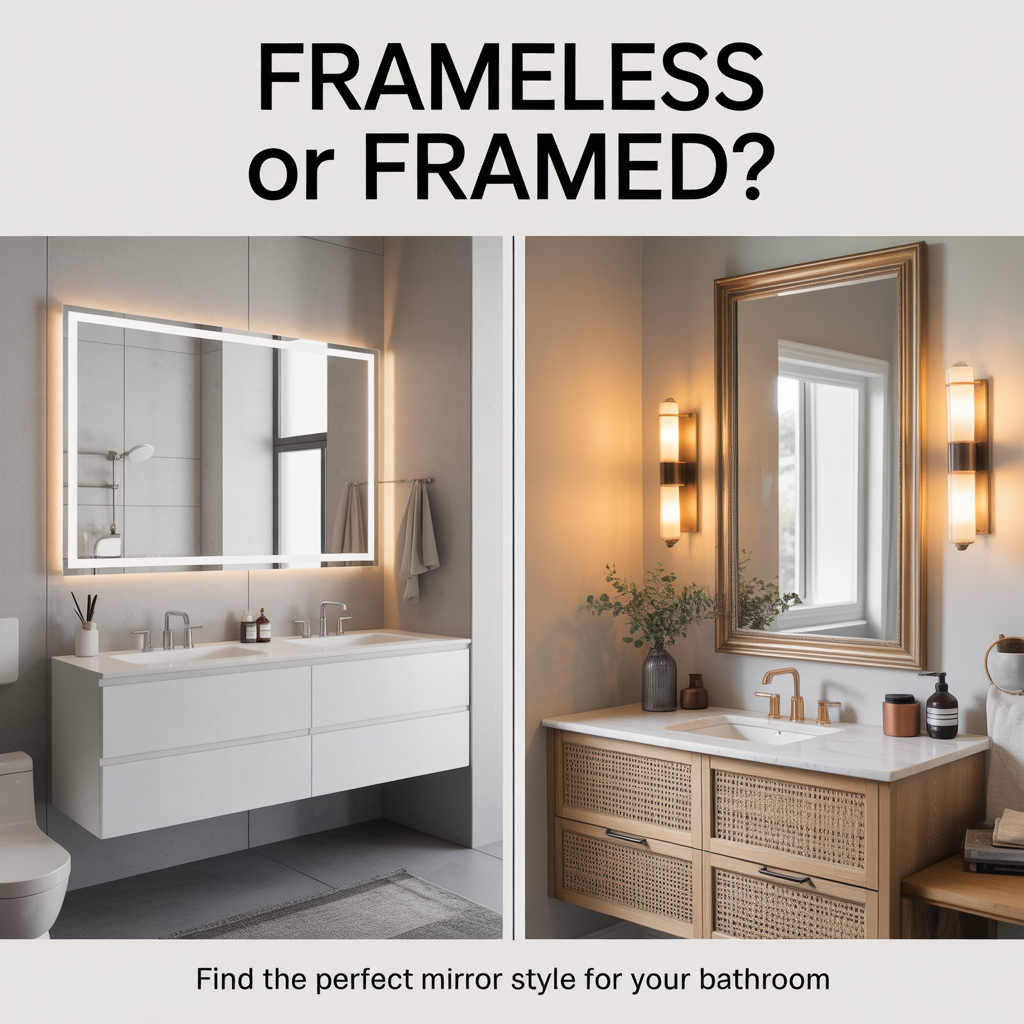
A frameless mirror is exactly what it sounds like — just glass, no border. The edges are usually polished or beveled, and the mirror either floats on the wall or is mounted flush against it. It disappears into the room rather than announcing itself.
A framed mirror has a border — wood, metal, plastic, tile, or anything else — that defines the shape and adds a visual presence. The frame is part of the design. You’re meant to notice it.
Neither is better in any objective sense. They solve different problems and suit different spaces.
When frameless works better
Frameless mirrors are the safer choice in most modern and contemporary bathrooms. If your space has clean lines, minimal ornamentation, and a neutral palette, a frameless mirror keeps things consistent. It doesn’t compete with anything.
They’re also genuinely useful in small bathrooms. Without a frame eating into the visual space, the mirror reads as part of the wall. The room feels more open. It’s a subtle effect, but it’s real.
Another underrated advantage: frameless mirrors age better with changing styles. A bold frame can date a bathroom fast. A frameless mirror just sits there, quietly working, through every trend cycle.
The downside is that frameless mirrors can feel cold or unfinished in the wrong context. If your bathroom has a lot of warmth — natural wood, warm lighting, textured surfaces — a frameless mirror might feel out of place. Like a tech product dropped into a cozy room.
When framed works better
Framed mirrors earn their place in bathrooms that have a distinct personality. Traditional, farmhouse, rustic, coastal, vintage — any style where the bathroom is meant to feel like a room, not just a functional space.
A well-chosen frame does something a frameless mirror can’t: it anchors the vanity area and gives the whole wall a focal point. It also adds warmth. A wooden frame in particular brings in a material that feels lived-in and human, especially in bathrooms that otherwise skew hard and reflective.
Framed mirrors are also better for people who want their mirror to make a statement. There’s a version of bathroom design where the mirror is the centerpiece — an ornate antique frame, a thick black metal border, a mosaic tile surround. That effect is simply not available with frameless.
The risk with framed mirrors is mismatch. A frame that doesn’t fit the rest of the hardware and finishes will look like it came from a different renovation. If your faucets are brushed nickel, a gold ornate frame is going to create tension that no amount of styling will fix.
Matching the frame to your existing finishes
If you go with a framed mirror, the frame needs to talk to everything else in the room. Not match exactly — but speak the same language.
Metal frames should echo the metal finishes you already have. Matte black mirror frame with matte black faucets and towel bars? That works. Brushed gold frame in a bathroom with chrome everything? That creates a fight nobody wins.
Wood frames are more forgiving. They pair well with warm-toned tiles, natural stone counters, and earthy color palettes. They also work surprisingly well in white-on-white bathrooms where you need one warm material to prevent the space from feeling clinical.
When in doubt, match the frame material to your vanity hardware — the drawer pulls and cabinet handles. Those small pieces are often overlooked, but when the mirror frame echoes them, the whole vanity area suddenly looks designed.
Practical differences worth knowing
Frameless mirrors are generally easier to clean. No frame means no corners where moisture and grime collect. In a bathroom that gets heavy steam — long showers, no good ventilation — a frameless mirror is lower maintenance.
Framed mirrors, especially wood ones, need more attention. Steam and humidity are hard on wood over time. If you love the look of a wood frame but your bathroom runs humid, look for sealed or painted wood rather than raw or lightly finished.
On price: frameless mirrors can actually run more expensive than basic framed ones, especially if they’re large or have beveled edges. Don’t assume frameless means simpler or cheaper. A large beveled frameless mirror costs real money. A simple metal-framed mirror from a home store might cost half as much.
The question that cuts through everything
Here’s the fastest way to decide: look at the rest of your bathroom. Is it more about materials and warmth — wood, stone, texture, character? Go framed. Is it more about space and simplicity — clean surfaces, minimal detail, open feeling? Go frameless.
If you genuinely can’t tell, frameless is the safer bet. It’s harder to get wrong. A frameless mirror in a warm bathroom reads as intentionally restrained. A framed mirror in a minimal bathroom reads as a mistake.
A quick comparison
Frameless
Best for modern and minimal spaces
Makes small rooms feel bigger
Easier to clean
Ages well through style changes
Can feel cold in warm spaces
Framed
Best for traditional and styled spaces
Adds warmth and character
Creates a focal point
More statement-making
Needs to match existing finishes
The bottom line
The mirror I have now is frameless. It suits my bathroom — modern, clean, no personality to speak of. But my parents have a thick black-framed mirror in their very traditional bathroom and it looks completely right. Neither of us made the wrong choice. We just made different choices for different rooms.
That’s really the whole answer. The right mirror isn’t the most expensive one or the most on-trend one. It’s the one that fits the room you actually have — not the room in the catalog photo.
Look at your space. Be honest about what it is. Then pick accordingly.