My guest bathroom is small. Not cozy-small. Genuinely cramped. Every time I showed it to someone, they’d do that thing where they step in, look around, and go quiet. You know the look.
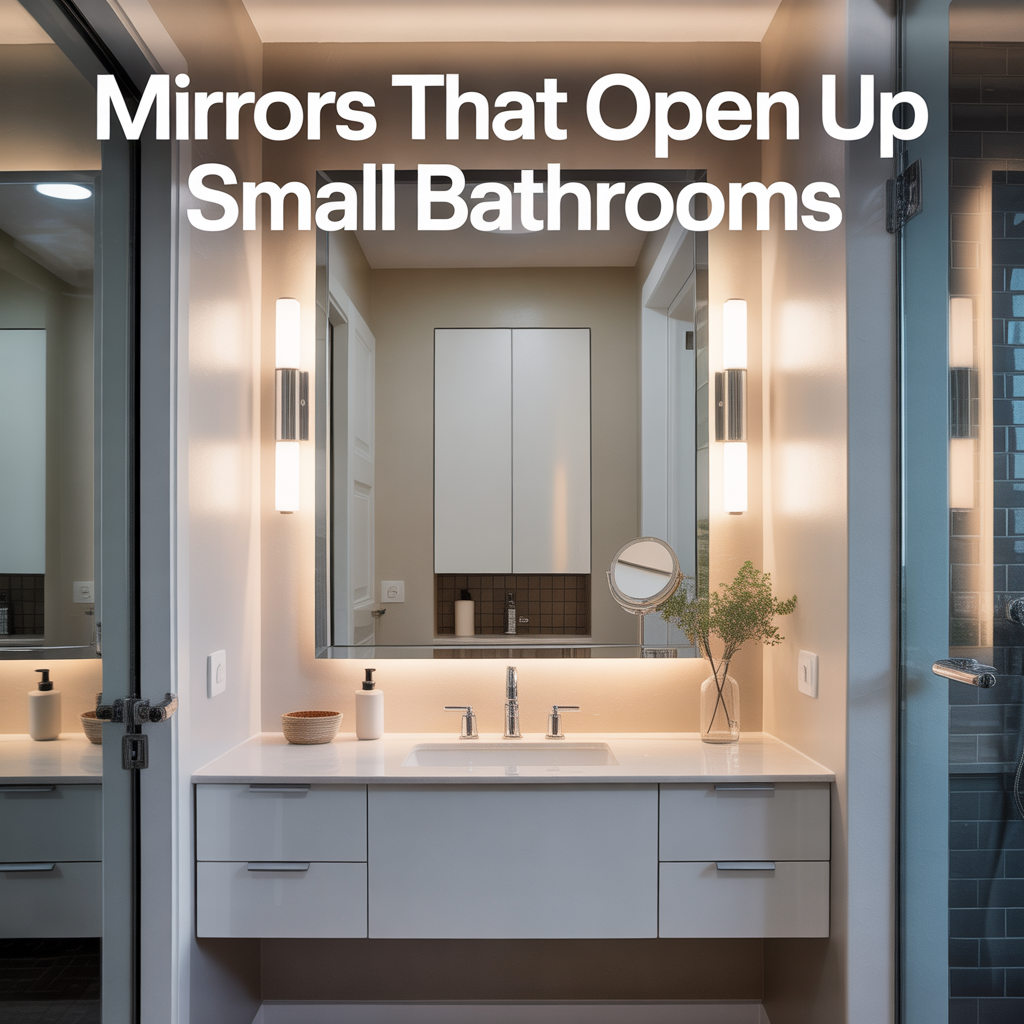
I tried a lot of things. New paint. Better lighting. A smaller vanity. Nothing moved the needle until I replaced the mirror. I went from a basic 24-inch frameless square to a tall, floor-grazing mirror that stretched almost to the ceiling. The bathroom didn’t get bigger. It just stopped feeling small.
That experience taught me more about mirrors than I’d learned in years of reading about interior design. Here’s what actually works.
Why mirrors make rooms feel bigger
It’s not magic — it’s just physics and perception working together. A mirror reflects light and creates the impression of depth. When you look into a large mirror, your brain reads it as space continuing beyond the wall. The room doesn’t end where the glass is. It seems to keep going.
The bigger the mirror, the stronger the effect. A small mirror does almost nothing for a cramped room. It just shows you your face. A large mirror changes how the room reads entirely.
Light is the other piece. A mirror opposite or adjacent to a window bounces natural light around the room. Even in a bathroom with no window, a large mirror amplifies whatever artificial light you have. Small bathrooms tend to feel dark. A big mirror fixes that without touching the electrical.
The best mirror types for small bathrooms
Not all mirrors create the same effect. Some are better suited to tight spaces than others.
Full-length or oversized mirrors are the most powerful option. If your wall allows it, a mirror that runs from near the ceiling down to just above the vanity backsplash draws the eye upward and makes the room feel dramatically taller. This is the single biggest visual trick available in a small bathroom and it costs nothing extra — a large mirror doesn’t always mean an expensive one.
Frameless mirrors work especially well in small spaces. The absence of a frame means the mirror blends into the wall rather than sitting on top of it. The eye doesn’t stop at a border. The effect feels more seamless, and the room reads as more open.
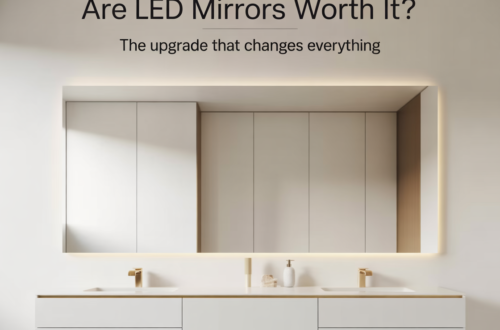
Backlit mirrors are worth considering if your bathroom runs dark. The light comes from behind the mirror itself, which eliminates harsh shadows and adds a soft, diffused glow to the whole room. In a bathroom with no window, this changes the atmosphere completely. They cost more than standard mirrors, but the combined effect of light and reflection is hard to replicate any other way.
Beveled mirrors — frameless mirrors with angled, polished edges — add a subtle depth effect at the border. The bevel catches light differently than the rest of the surface, which creates an impression of dimension. It’s a small detail, but in a small room, small details add up.
What to avoid in a small bathroom
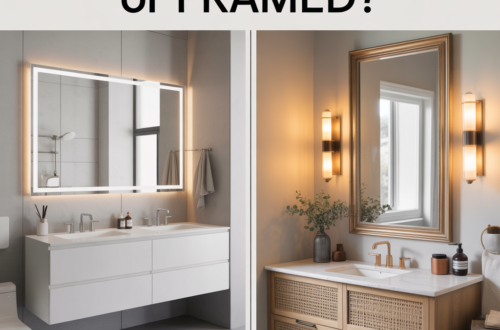
Thick frames. A chunky frame — especially a dark or heavy one — creates visual weight that a small bathroom doesn’t need. It makes the mirror look smaller than it is and adds mass to the wall. In a tight space, you want things to feel light and receding, not solid and present.
Multiple small mirrors. I’ve seen this approach tried a hundred times — a cluster of decorative mirrors arranged artfully above the vanity. It almost never works in a small bathroom. Each individual mirror is too small to create depth, and together they add clutter. One large mirror beats three small ones every time.
Mirrors placed too low. A mirror that sits at face level and no higher cuts the visual height of the room. You want the mirror to reach up — ideally as high as the ceiling allows, or at minimum a few inches above where most people’s heads sit. Height is what makes a room feel open.
Placement matters as much as size
Size is the most important factor, but placement is close behind. A large mirror in the wrong position loses most of its effect.
If you have a window, even a small one, position the mirror where it can catch and reflect natural light. Directly across from the window is ideal. Even at an angle helps. Natural light reflected off a large mirror can make a dark bathroom feel like it has a second window.
Height is the other variable. Hang the mirror higher than feels natural. Most people hang mirrors at eye level as a reflex. In a small bathroom, you want the mirror to extend well above eye level — close to the ceiling if the proportions allow. That upward extension is what creates the sense of height.
If you’re working with a double vanity in a tight space, one large mirror spanning both sinks will almost always look better than two individual mirrors. It creates a single continuous surface of reflection instead of two broken ones.
Practical things to keep in mind
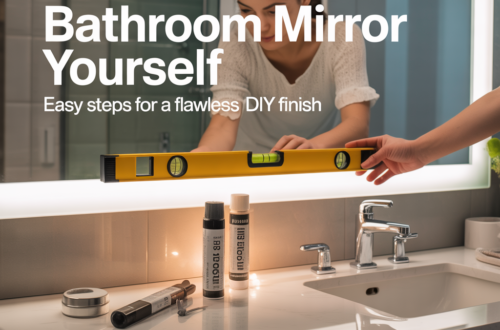
Large mirrors are heavy. Make sure your wall mounting can handle the weight — anchor into studs where possible, especially for mirrors over 30 pounds. A mirror that falls is dangerous and expensive.
Steam and moisture will eventually affect any mirror in a bathroom that lacks ventilation. If your small bathroom runs humid, look for mirrors with moisture-resistant backing. The extra few dollars upfront saves you from replacing a fogged, deteriorating mirror in a few years.
Cleaning a large mirror takes more effort than a small one. That sounds obvious, but it’s worth thinking about before you commit to a floor-to-ceiling panel. A good squeegee after every shower keeps it clear without much effort.
How much bigger can a mirror actually make a room feel?
More than you’d expect. I’ve seen bathrooms where changing just the mirror made the room feel 30 to 40 percent larger — not in actual square footage, obviously, but in how it registers when you walk in. That’s a significant perceptual shift for something that takes an afternoon to install.
It’s also one of the cheapest improvements available in bathroom design. A paint job costs more. New fixtures cost more. Even a decent set of towels costs more than a basic large frameless mirror. The return on visual impact per dollar spent is hard to beat.
The short version
+Go as large as the wall allows — height especially
+Choose frameless over framed for a more open feel
+Position to catch natural light if possible
+Hang higher than feels natural — reach toward the ceiling
−Avoid thick frames, dark borders, multiple small mirrors
−Don’t hang the mirror too low — it cuts the room’s height
My guest bathroom still gets the quiet reaction when people walk in. But now it’s a different kind of quiet — the kind where someone is trying to figure out why a small bathroom doesn’t feel as small as it should.
That’s the mirror doing its job.