A friend of mine is selling her house this year. She spent two months going back and forth on whether to repaint her kitchen cabinets before listing — and if so, what color. Her real estate agent said white. Her designer friend said beige. Her husband said leave them as they are, which was a dated oak that everyone agreed was the one thing nobody wanted.
She went with beige. The house sold in eleven days.
That’s one data point, not a verdict. But it opens a real question that a lot of homeowners are asking right now: in a market where kitchen updates can meaningfully affect sale price and time on market, does cabinet color actually matter — and if it does, which direction should you go?
What “adding value” actually means
Before getting into colors, it’s worth being precise about what we mean by value. There are two things a cabinet color can do for your home’s worth. First, it can make buyers more likely to put in an offer — reducing friction, broadening appeal, generating faster sales. Second, it can support a higher asking price by making the kitchen feel more finished, more current, more worth the number on the listing.
These are related but not identical. A kitchen that photographs well generates more interest and faster offers. A kitchen that feels genuinely high-quality in person supports a higher price. Cabinet color affects both, but differently, and it’s worth keeping that distinction in mind.
The case for white — still real, just changing
White cabinets became the default recommendation for pre-sale kitchen updates for a good reason: they photograph extremely well. Bright, clean, light-filled kitchen photos generate more clicks on listings. More clicks mean more showings. More showings mean faster offers. The logic was sound when white was the dominant trend, and it held up for years.
White also reads as fresh and updated to a broad audience. Buyers who can’t quite articulate what they want often respond to white kitchens with “it feels clean” and “it feels new” — both of which are useful associations when you’re trying to sell.
The limitation is that white kitchens are everywhere now. A decade of everyone choosing white for pre-sale renovations means buyers have seen hundreds of white kitchens in listings. The distinctiveness that made white feel premium has eroded. It no longer stands out. It just looks like every other kitchen that was updated before listing.
There’s also the maintenance perception problem. Sophisticated buyers — the ones who look closely — know that white cabinets show wear faster. They’re thinking about what the kitchen will look like in three years, not just on moving day. That calculation has started working against white in some market segments.
The case for beige — stronger than it was two years ago
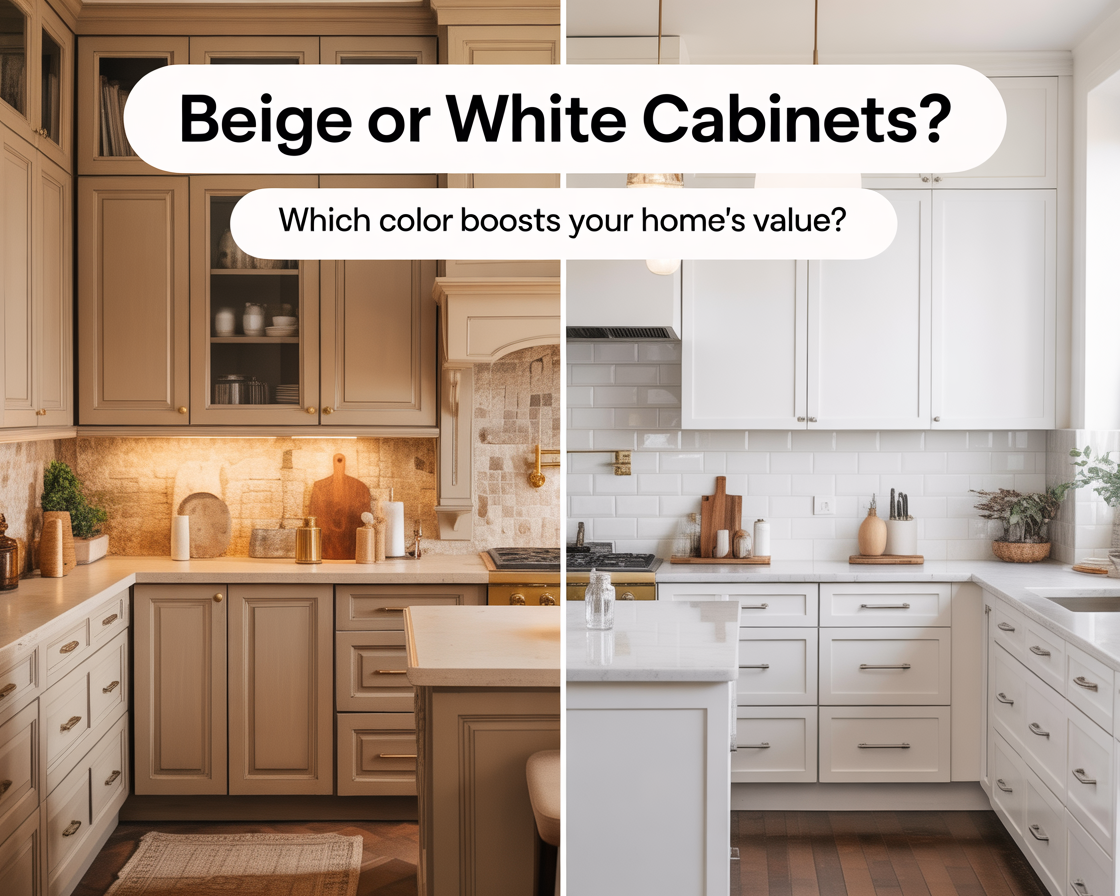
Beige cabinets in 2026 carry something white currently can’t offer: they feel current without feeling calculated. White reads as a pre-sale choice because it has been a pre-sale choice for so long. Beige reads as a design choice — like someone actually thought about what they wanted rather than defaulting to the safe option.
That perception matters in person. Buyers walking through a home register — often unconsciously — whether a space feels genuinely considered or just prepared for sale. A beige kitchen, done well, feels like a home. A white kitchen, at this point, often feels like a staging decision.
Beige also photographs warmly. It doesn’t have the same clinical brightness as white, but warmth in listing photos reads as welcoming rather than cold — and welcoming generates emotional responses that clinical brightness doesn’t. In a competitive market, emotional resonance is not a small thing.
The practical argument for beige is also compelling: it hides the evidence of use better than white. Buyers who are thinking about the long game — and in this market, many of them are — respond to a kitchen that looks like it will age gracefully rather than one that requires constant upkeep to maintain its appearance.
What the market data actually shows
Hard numbers on cabinet color and resale value are genuinely difficult to isolate. Too many variables — location, price point, overall kitchen quality, listing photography, market conditions — interact with color to make clean causation impossible. Anyone claiming precise ROI figures for beige versus white is oversimplifying.
What is clear from real estate and renovation research is that kitchen updates consistently return between 60 and 80 percent of their cost in resale value, making the kitchen one of the highest-return rooms to update before selling. Within that, the update that generates the most return relative to cost is paint — including cabinet paint. A professional cabinet repaint runs a fraction of new cabinets and delivers comparable visual impact in listing photos.
Color preference also varies meaningfully by market. In urban markets with younger buyers, warmer and more distinctive colors have been gaining ground faster than in suburban markets where broader appeal still tends to favor neutrals. A beige kitchen in a major city with a design-forward buyer pool may outperform white. In a suburban market with conservative buyer preferences, white may still edge it out. Local knowledge matters more than general trend data here.
The condition question nobody asks first
Here’s the thing that gets skipped in the beige versus white debate: the condition of your cabinets matters more than the color. A fresh coat of warm beige on well-maintained cabinet boxes with updated hardware will outperform a white repaint on cabinets with damaged doors, worn hinges, and cheap pulls. Every time.
Before deciding on color, assess the structure. Are the cabinet boxes solid? Do the doors hang properly? Is the hardware dated in a way that a repaint alone won’t fix? If the answer to any of those is no, address the underlying issues first. Color is the finish line, not the foundation.
Hardware is also underestimated in this conversation. New hardware — matte black, brushed brass, unlacquered bronze — can transform the reading of cabinet color entirely. A beige cabinet with updated hardware looks designed. The same beige cabinet with original builder-grade brass pulls from 1998 looks like someone painted over a problem.
So which one actually adds more value
Probably beige, right now, in most markets — but not by the margin that trend coverage would suggest. The real answer is that neither color adds meaningful value on its own. What adds value is a kitchen that looks fresh, feels current, and reads as cared for. Both colors can achieve that. Both can also fail to achieve it if the execution is poor.
White still works in markets where it hasn’t been overdone, where listing photography is a primary driver of interest, and where buyers skew toward broad conventional appeal. Beige works better where buyers are more design-aware, where the kitchen will be seen in person before a decision is made, and where standing out from comparable listings matters.
If you’re genuinely uncertain, talk to a local real estate agent who actually tracks what’s selling in your specific neighborhood — not what’s trending nationally. The best color for resale is the one that buyers in your market respond to, and that varies more than any general article can capture.
And if you’re not selling
If you’re choosing a cabinet color for a kitchen you plan to live in for years rather than sell immediately, the value question is almost irrelevant. Paint is reversible. Trends shift. The color that makes your kitchen feel like the most enjoyable room in your home to cook and eat and spend time in is almost certainly the right choice — regardless of what a future buyer might prefer.
My friend’s house sold quickly with beige cabinets. But she also told me she was genuinely sad to leave that kitchen. It looked good in the listing photos and it felt good to cook in. That combination — practical resale value and genuine daily enjoyment — is what a good cabinet color decision actually delivers.
That’s worth more than either color alone.